
What is in my Camera Bag - 2024
IN PARTNERSHIP WITH FUJIFILM

Possibly my most asked question - which always makes me laugh as I put myself as an athlete first and photographer a distance second. And I have to preface this with… the camera truly does not matter. What matters is knowing how to use the tool you have in your hand and having a camera that makes you excited to go out and capture the world around you. The hesitancy with releasing this blog is that the photos that drive these questions are taken by every camera under the sun… with very talented people behind them.
I will be running through, on this blog, what I personally bring with me when shooting self portraits for my social media, landscape images for my blog and product photos for my clients.
My Camera Bodies
I began my photography journey with a Canon PowerShot ELPH 300 circa 2007 (I recently found it in my parents’ basement…. with a battery exploded inside of it). I then moved on to borrowing my dad’s Canon EOS Digital Rebel T2i before switching to the Sony ecosystem with the a6000 sometime in 2015 - and I realize the hypocrisy of saying that the camera does not matter leading into this story. Because shooting on that Sony camera truly made me lose my love for photography. I never picked it up or even packed it when I went out. I had a hard time editing anything that came out of camera and it took me so long to try and find anything in the menu settings that I just… stopped. For years. I became the best model that I could be. I began telling stories in my captions. And built out my blog (hey!) I understood composition and would direct how I wanted my images to look, reviewing back of camera and demanding re-shoots. I learned to edit in a style that I loved and… then I wanted more. So I turned to Fujifilm. In all honesty the lower price point for same (or sometimes better) quality caught my eye. And when I picked up my X-T30 in 2019… the colours out of camera made my heart sing. Slowly but surely I fell back in love with the craft.
I have linked the gear that I use - if you are interested in purchasing any of it - using the links is so greatly appreciated. It adds no cost to you but does offer me a small commission. Which helps fund this website and helps me offer all of my resources free of charge to you.
Fujifilm X-T5

I picked up this camera after feeing as though I had outgrown my X-T30. I love it - it offers an APS-C 40-megapixel X-Trans 5 HR CMOS sensor powered by a new X-Processor 5 in a body smaller than its predecessor the Fujifilm X-T4 (all of the specs are listed in the drop down menu below). it captures truly beautiful photos, I have, however, found a few slight drawbacks. The fist of which being the autofocus on the intervalometer mode. If you recall this is how I take my self portraits.
I found that the subject (me) needs to be in frame for the first image to properly focus. This is a major limitation for me that would not be an issue for the vast majority of photographers. I have started to place a prop in the focal plane that I am intending on being in and it seems to pick up my face as I move around the frame as long as this first image is in proper focus. It is quite annoying and has resulted in a lot of wasted shots (and missed perfect light opportunities) for me.
The second which is widely spoken about is the video mode. Although it has worked well for me (you can find examples of reels that I have self filmed on the X-T5 here, here, here, here or here) and the autofocus seems flawless in video mode. If your primary function is video I would recommend a camera such as the Fujifilm X-H2S.
Overall I am very happy with this camera especially given the price-point being much lower than most of its major competitors. I also love the hand feel of the camera and the menu system and design make this a really easy to understand (or learn) and fun to use camera.

-
Body type : SLR-style mirrorless
Max resolution : 7728 x 5152
Effective pixels : 40 megapixels
Sensor size : APS-C (23.5 x 15.6 mm)
Sensor type : BSI-CMOS
ISO : Auto, 125-12,800 (Expands to 64-51200
Lens mount : Fujifilm X
Focal length mult. : 1.5×
Articulated LCD : Tilting
Screen size : 3″
Screen dots : 1,840,000
Max shutter speed : 1/8000 sec
Format : H.264, H.265
Storage types : 2x UHS-II SD
USB : USB 3.2 Gen 2 (10 GBit/sec)
Weight (inc. batteries) : 557 g (1.23 lb / 19.65 oz)
Dimensions : 130 x 91 x 64 mm (5.12 x 3.58 x 2.52″)
GPS : None text goes here


Fujifilm X100V

This little camera is what made me fell back in love with photography. Mike brought it on the Haute Route with us in 2021 as a backup to his full frame camera set up. He used it for capturing in the moment experiences and our (mis)adventure on the trail. As soon as we returned home to Canada I went on Facebook marketplace and bought my own. A few months later this camera exploded in popularity (for good reason) and has been near impossible to acquire ever since.
It is so fun to use and is small enough to fit inside of my fanny pack or most jacket pockets (yes, even women’s jacket pockets!). It has film simulations built in so even right out of camera you can directly upload your images (jpeg only) to the fujifilm app (Cam Remote) and they are ready for your social media or memo sharing needs.
Unfortunately the X100V is no longer available and has been replaced by the X100VI which hopefully one day I will get to try out - but is a new and improved version of this absolutely incredible little camera. I have linked it below.

-
Body type : Large sensor compact
Max resolution : 6240 x 4160
Effective pixels : 26 megapixels
Sensor size : APS-C (23.5 x 15.6 mm)
Sensor type : BSI-CMOSISOAuto, 160-12800 (expands to 80-51200)
Focal length (equiv.) : 35 mm
Max aperture : F2–16
Articulated LCD : Tilting
Screen size : 3″
Screen dots : 1,620,000
Max shutter speed : 1/4000 sec
Format : MPEG-4, H.264Storage typesSD/SDHC/SDXC card (UHS-I supported)
USB : USB 3.2 Gen 1 (5 GBit/sec)
Weight (inc. batteries) : 478 g (1.05 lb / 16.86 oz)
Dimensions : 128 x 75 x 53 mm (5.04 x 2.95 x 2.09″)
GPS : None


Fujifilm X-T30

This is my backup camera now, I purchased it in 2019 and absolutely love/d it. It to this day surprises me every day with how compact, lightweight and intuitive it is to use and offers beautiful photo quality. Unlike the X-T5, it is not advertised as being weather sealed however, it has come out with me in the rain and (unfortunately) hung out in a damp backpack a number of times without issue.

-
Body type : SLR-style mirrorless
Max resolution : 6240 x 4160
Effective pixels : 26 megapixels
Sensor size : APS-C (23.5 x 15.6 mm)
Sensor type : BSI-CMOS
ISO : Auto, 160-12800 (expands to 80-51200)
Lens mount : Fujifilm X
Focal length mult. : 1.5×
Articulated LCD : Tilting
Screen size : 3″
Screen dots : 1,040,000
Max shutter speed : 1/4000 sec
Format : MPEG-4, H.264
Storage types : SD/SDHC/SDXC card (UHS-I supported)
USB : USB 3.2 Gen 1 (5 GBit/sec)
Weight (inc. batteries) : 383 g (0.84 lb / 13.51 oz)
Dimensions : 118 x 83 x 47 mm (4.65 x 3.27 x 1.85″)


Lenses


My first time bringing this lens was on my 30th birthday to French Polynesia. I borrowed it from Fujifum for a month and immediately fell in love. I borrowed it near constantly until they told me that I needed to buy my own. And also I did. This lens gives me the flexibility of shooting everything from landscapes to portraits to up close detailed shots.
Note that as the two camera bodies I own are both crop sensors, this lens equates to approximately a 24-85mm.


I first became interested in photography because of my obsession with the sky. The shapes of clouds as they moved past, the desire to see what the surface of the moon looked like - the distant layers of mountains. I knew that a telephoto lens would become integral in my photography career and this lens is one I have fallen in love with. It does add a lot of weight to my backpacking set up so I am intentional when I bring it with me. But on a full moon backpacking trip in French Polynesia, on my sailing to Antartica and on many hikes in Patagonia is has proved its value.
Note that as the two camera bodies I own are both crop sensors, this lens equates to approximately a 75-210mm on a full frame camera.


1.4x extender
I use this Fujifilm XF1.4X TC WR Teleconverter for Fujinon XF50-140mm F2.8 R LM OIS WR Lens exclusively for getting up close and personal with the sky above. For saying goodnight to the sun and good morning to the full moon.
Note that as the two camera bodies I own are both crop sensors, in conjunction with the above telephoto lens, equates to approximately a 112-294mm on a full frame camera.


Accessories

camera clip
Likely 50% of the reason you searched for this blog was he answer to “how in the heck do you attach our camera to your backpack strap?” - well you have finally reached the answer. I sue the Peak Design Capture 3.0 Camera Clip. It uses the same plate as all other Peak Design accessories (like my tripod) and comes with several different lengths of screws to fit even the thickest of backpack straps.
This clip does take a little getting used to (I find it digs into exposed skin sometimes when I have a heavier camera/lens combo) and on longer backpacking trips I will swap shoulders to even out the added weight. But this is truly one of the best pieces of gear to help capture moments on the go.


Camera Strap
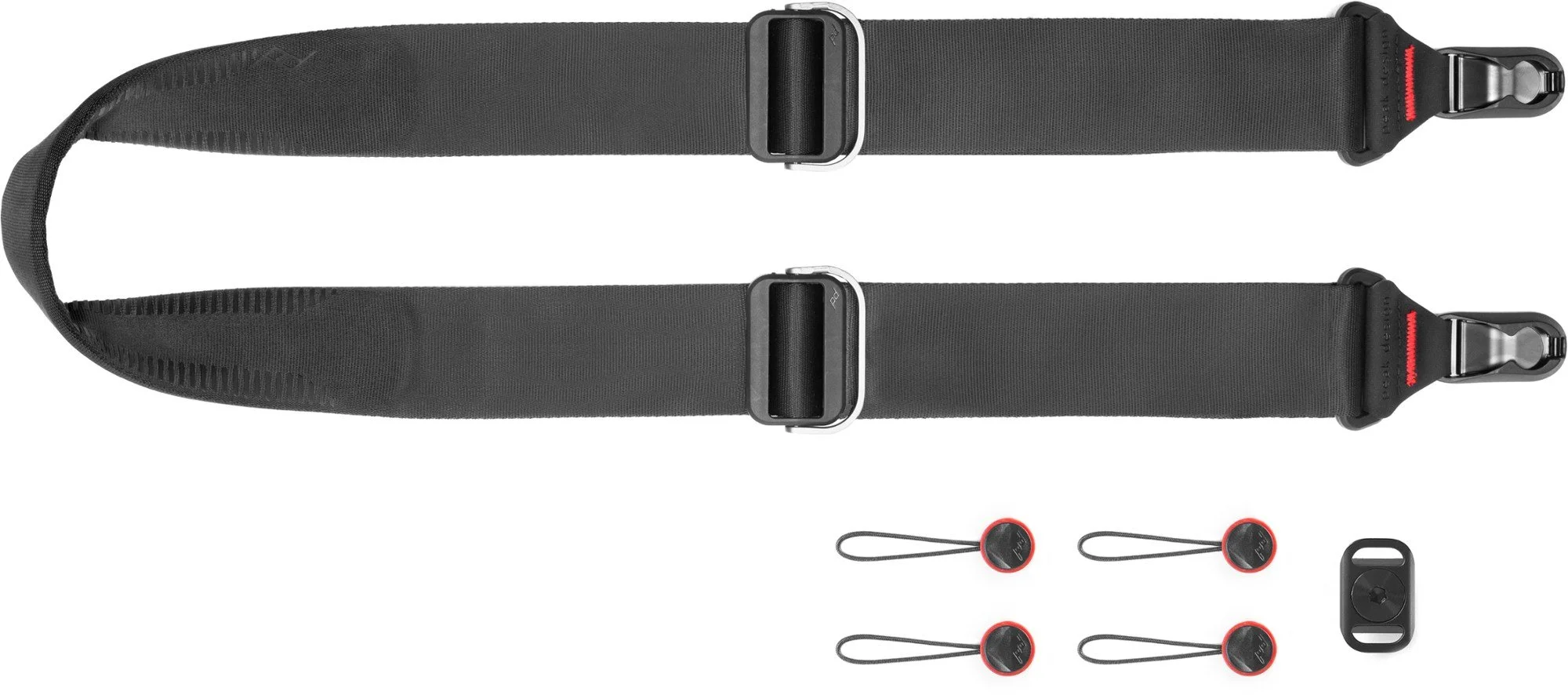
Sticking with the Peak Design ecosystem I use the Peak Design Slide Strap 2.0 Camera Strap on all of my bodies. The anchor links allow for it to be taken off and put on really easily (again, allowing for quick exchange to a wrist strap or other accessory).

tripod
I bought the Peak Design Carbon Travel Tripod in 2021 to take with me on a solo that turned into not so solo trip to Patagonia (you can read about my O-Circuit hike here). I brought only my X100V and this tripod. It was amazing. This tripod does have an extremely high price point but the weight to sturdiness value is unparalleled. It does need to be babied (I checked mine in a suitcase once and it sustained some damage) but if you take care of it there is truly no better tripod not he market. It also has an integrated phone holder so I am able to record on either my camera or my phone.


extra batteries and memory cards
Just in case, and for long backpacking trips. Bonus: Fujifilm batteries can charge in camera with a USB cord.
I try to bring enough memory cards that I am able to keep a copy of my images on the memory cards, a copy on my laptop hard drive and a copy on my external hard drive. I do this just until I can get home and back everything up!
& to carry it all
I use the Peak Design Tech Pouch for all of my odds and ends. I always keep a spare Allen key (for my mount), iPhone holder (it is honestly quite flimsy and has broken in the past) , batteries, SD cards, SSD Harddrives, lens wipes… all of the things that you might need on the trail or when traveling.

*Please note that some of the links above are affiliate links, and I may earn a small commission on any purchase made - at no additional cost to you. As always, all ideas and opinions expressed in this post are entirely my own. Thank you for your support!


