The Tour du Mont Blanc - the ultimate guide to hiking around the Mont Blanc Massif
I did my first thru hike in the Alps (also coincidently beginning in the town of Chamonix) in 2021 - when life was a little bit different. And if I am being honest I vowed never to do another. It felt so so hard and I overpacked and if I am being honest from a photography standpoint they kind of make life a lot harder. You are at the hut, eating, during the best light of the day. Which I know is not a consideration of most. But it is for me.
Well, that vow did not last. And since 2021 I have near annually gone on a hut hiking trip. So call me a liar. But when I found myself with an extra three weeks in the Alps… and a need to be in Chamonix I did decide to tackle a piece of arguably the most ronound thru hike in the world. The Tour de Mont Blanc.
I had one week and was not looking to kill myself with distance and elevation as I was training for the Berlin Marathon. I also did not need to overlap with days from my 2021 trip along the Haute Route. And so I opt’ed for a solo one week (half) loop of Mont Blanc.
This blog goes over more generally the TMB - booking and picking huts and thing you should know before heading out on a full, half or any section of the TMB. For my personal experience and itinerary - you can find that here. And for everything you should pack (and nothing more) - I have you covered here.
Before I get into this, just a general disclaimer that I did my best to put together all of the information I learned/found to the best of my ability. It is, to my knowledge, accurate as of Summer 2024 when I completed this solo trip.
More Alps Hut Tips:
Haute Route Packing Guide
Haute Route Part 2 (Chamonix to Zermatt)
6 Amazing Swiss Mountain Huts

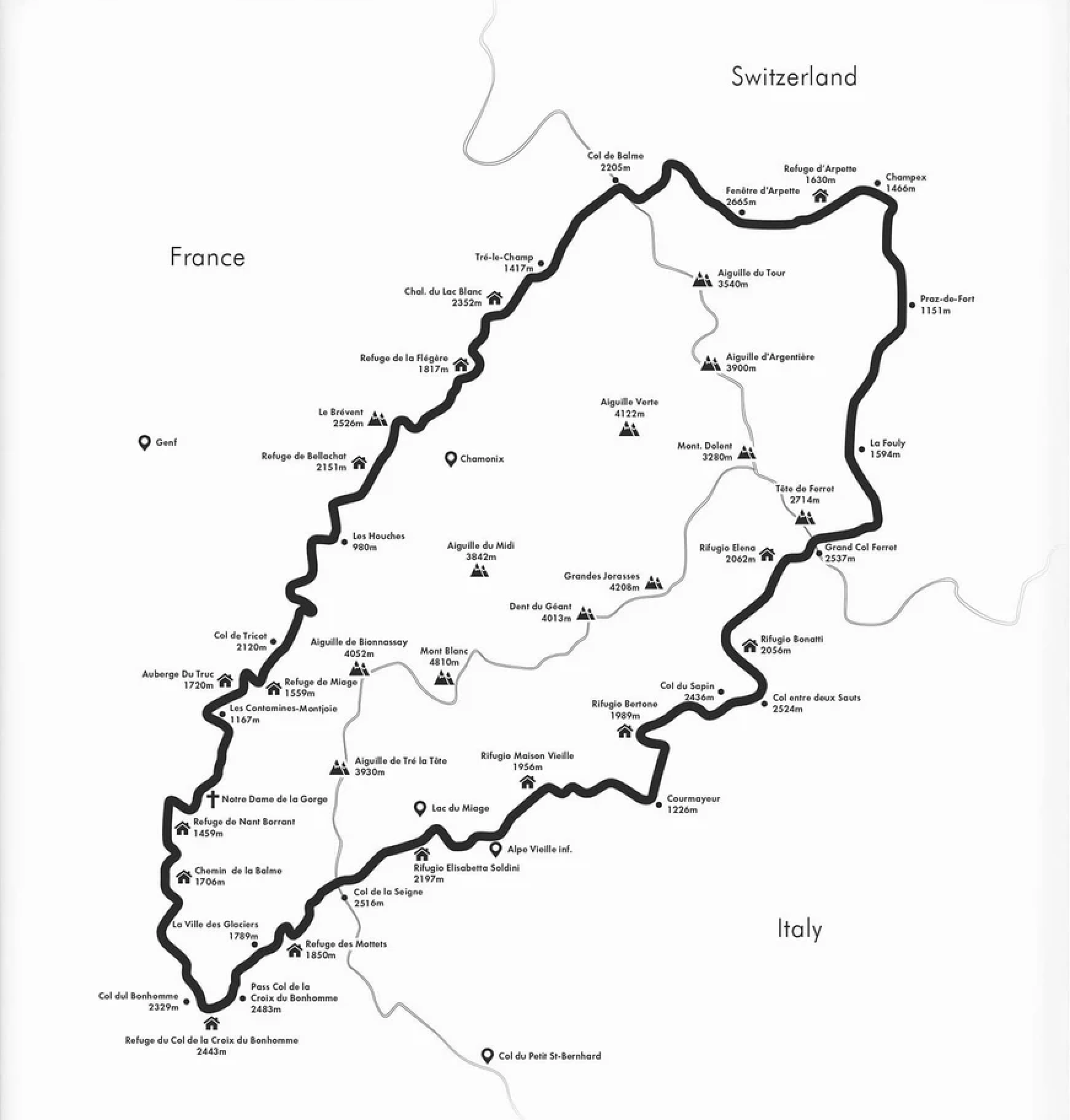
The (full) Tour du Mont Blanc Map
What is the tour du Mont Blanc?
The Tour du Mont Blanc (TMB) is one of the most iconic thru hikes in the world. Over 200,000 people hike, run and bike the TMB annually, it is considered the most popular long-distance hike in Europe. Ir circumnavigates the Mont Blanc massif - crossing through France, Italy and Switzerland.
The TMB is also home to the UTMB (Ultramarathon Tour de Mont Blanc) every year in late August. This is a week + long event in which over 3,000 world class ultra marathon runners race around the 176km trail that is the TMB. It beings and ends in Chamonix, France and is something to be aware of when planing your trip.
As with most multi-day trails in the Alps there is a “main / classic” route and then many variations, shortcuts and detours for hikers to choose from on the networks of mountain paths. The main route is:
Difficulty: Medium-high
Distance: 166km / 103mi
Duration: 10 (at Steady pace)
Highest point: 2,526m / 8,287 ft
Total elevation gain: 10,000m / 32,700 ft
Number of mountain passes: 10
When to hike the TMB?
Mid-July to mid-September seems to be the consensus on the best time for the TMB Season. Early to mid-September is an especially enjoyable time to be on the TMB hike since September typically has less rain and a more stable weather pattern than either July or August, but the days are a lot shorter as the season goes on.
Accommodation in huts is often full during July and August so plan to book those in advance. However, by mid September a number of the huts along the route begin to close - but those that were open seemed to be available with a day or two notice (especially during the weekdays).

The Haute Route
How long does it take to hike the TMB?
The most common itinerary takes around 10 days to walk the TMB. It can be condensed into fewer or stretched into longer for a more relaxed/enjoyable pace.
For me, on this trip. I was limited to one week. And as I had already hiked the Hate Route which intersects with the TMB (mostly the Swiss section) I opt’ed for a condensed TMB that would cover most of the ground that I had not yet seen and included a few add on’s that I think are more than worth the detours.
There are a million and one traditional TMB blogs out there and I encourage you to find them if that is what you are looking for. But I am here to share my experience. I worked with My Hiking Guide to build my own custom seven day (6 night) half circumnavigation of the Mont Blanc massif.
Is it safe to hike without a guide or as a solo person (male or female)?
One of the main questions about this trail is: can you do the TMB without a guide?
100% yes. Hiking the TMB without a guide is what most people do - I hiked it alone as a woman with no guide. There was not a second on this trip that I felt unsafe and in the summer a mountain guides are not necessary. Most of the trail had cell phone service and there are people everywhere (nothing more demoralizing than 9 hours of extremely difficult hiking to meet up with a family of 5 piling out of a mini van).
The huts were safe and the staff, fellow hikers and alpinists were so friendly; everywhere we went people were offering us stories about their self guided haute route experience, as well as really cool information about the hut, the mountains or the region and even a few glasses of wine and cups of espresso.
Almost all of the trail is marked (red and white for easy trail, blue and white for more challenging terrain) with signs indicating direction and hiking time to the next point of interest(examples below). We also had a gps map on our phone if we wanted to triple check anything.
As a note, in North America I find those time/distance signs time estimates to be pretty slow - in Western Europe they are accurate for a quite quick hiker.


Where to fly into for the TMB?
Geneva is the nearest airport. From there you can take a bus (around 1h 30) that costs ~20CHF. The bus company I used can be found and booked online here.

Traveling by train from Zurich to Chamonix
How did you decide on a route?
I planned my trip (very) last minute and mostly planned based on a time constraint (I was crewing a friend running in the UTMB) as well as wanting to see parts of the trail I had not yet seen. And in the end tacked on a visit to my personal favourite hut.
I built my route with The Hiking Club - for €79.00 they will help you plan your trip down to the smallest detail. They will provide access to a planning portal from which you will be provided a personalized itinerary, interactive GPS map (including recommended grocery stores, restaurants, pubs and coffee shops along the route and pricing for different transportation options as well as which stops to get on/off of) and support (if need be) while on the trail.
I simply filled out a questionnaire in the portal regarding how many days I wanted to be on the trail, how far I was anting to hike each day, which mountain huts were important that we saw and if we wanted to take additional transportation (such as gondolas, busses, funiculars and trains) when available. Based on my answers I was given a route with the option to change things or customize based on how I felt. Which I did.
And if the above information isn’t confusing enough, there are 6 major trails in this region (the TMB hike being one of them). Click the map below for a brief overview of all of options. You can combine any of these trails and build your own adventure. There are so many trails (and over 1,300 huts) all across Europe.

Can you camp instead of staying in huts?
Yes. A number of the other TMB hikers that I saw were doing a combination of camping and huts. The Hiking Club can plan your route based on camping vs. huts vs. hotel and even by price.
For example, initially I had planned to stay in the town of Courmayeur, Italy on the first night of this trip. However with the UTMB in town the accommodations were nearly sold out and everything was SO expensive so I last minute checked availability and snuck into Rifugio Maison Vieille - which ended up being such a vibe.
I personally love camping but opted out of it on this trip for two reasons:
I wanted to experience the European hut system and;
My bag were already very heavy (without camping and cooking gear) and I was race training so I was trying to keep my legs as fresh as possible (foreshadowing all of the gondolas I took here) - so huts it was!
You didn’t hear it from me, but there are technically two ways to camp:
Officially: There are campsites all along the TMB. They get a little busy during the summer months but they are cheap (between 10 and 15 CHF per night), and generally offer some (or all) of the following services: WiFi, kitchen, laundry, showers, and plug ins for your electronics. Not your North American campgrounds by any means.
Not-so officially: “Wild camping” is not legal, yet is possible in the higher, undeveloped areas. It is more commonly referred to as “Bivouacking” or “camping between dusk and dawn with a non-permanent structure, such as a tent, in a non urban area (above treeline)” - there are a number of areas along the route that this is strictly forbidden. The below button provides a lot more information.
Regardless, stay in at least a few huts. They are worth the splurge for the experience (and food) alone.

What are the mountain huts/refuges like?
Mountain refuges on the TMB walk are nothing like North American hiking huts. They range from high alpine hotels to more dormitory style rustic hostels. Most along the Haute Route are found in remote locations or high altitude that can only be reached by foot or helicopter. I will note that I found the huts along the TMB to be a lot more run down than in other parts of Europe. I assume this is because of the sheer volume of people but I would sat to lower your expectation of the huts (with the exception of Albert 1er) along this trail. They were very much on the hostel side of the spectrum.
The rooms in the huts are large and contain anywhere from 4-16 beds(generally bunk beds stacked two or three high).
You’ll be provided with a mattress, pillow, and blanket, but you will need to bring your own sac à viande (meat bag or sleeping bag liner) and pillowcase. I outline all of this in my packing guide.
Most TMB refuges provide half-pension (also called demi-pension or half board). This includes your bed for the night, as well as dinner and breakfast. Dinner is often a lavish, multi-course affair.
They can typically cater to vegetarians, vegans and those with gluten free diets with a few days notice. Breakfast is very simple and typically consists of cold cereal, bread with butter and jam, and tea/coffee.
Although you can bring your own food, I found the dinner to always be worth the cost - even if the breakfasts were very basic compared to what I am used to. Plus, it’s a very social time to swap stories with fellow hikers and alpinists alike.
The cost of these huts vary from 60 - 150 euro(or CHF) per night including half-pension.
Notes that apply to some, but not all, of the huts:
Alcohol and snacks can be purchased a-la-carte.
A packed lunch can usually be ordered for the next day (around 20 euro/CHF)
Electronic charging may be an additional fee
Showers are typically 5 euro/5 minutes
Most huts have wifi and service - but not all.
Not all have potable water, I brought a SteriPen for these but bottled water can also be purchased
Bed bugs have been reported in some huts, call in advance
Bathrooms are shared
The huts get really warm, even at low capacity.
People snore, bring good quality earplugs.


What languages are used along the route?
French, and Italian are the two main languages (French in France and Switzerland and Italian in Italy). I speak French and it was helpful albeit not necessary - the vast majority of people know at least little English.
Just be extra patient and appreciative - remind yourself often that if they are speaking English to you that they are doing you a favour as it is their country in which English is not one of their native tongues. And download a translation app.

What do you eat on the TMB?
On my overnight stays in huts I purchased “half board” - mentioned above. Fun fact that I learn form hiking the haute Route in 2021 - you can ask for a second helping of dinner - or third which was the case with some pretty hardcore mountaineers we ran into. For lunch I popped into other alpine huts along the way and would buy my lunch and a bottle of coke and enjoy it on the patio. This is not the most cost effective route but it was the experience I was wanting.
At a restaurant or mountain hut:
Beer: 5 euro
Coffee: 5 euro
Pastry : 6 euro
Packed lunch from mountain hut: 10-15 euro
Sandwich from a mountain hut: 5-8 euro
Hot lunch plate (polenta, pasta etc) 15-20 euro

Notes from The Hiking Club about food
What to bring: snacks
I'm going to leave this to you to decide what to bring. I bring some muesli bars, nuts, chocolate and hydrolite with me as these are my baseline snacks no matter where I'm hiking in the world and pick up other snacks and things for lunch on arrival
Are there snacks on the TMB trail?
For your bigger snack/lunch restocks, supermarkets/convenience stores are located in the following villages on the trail Les Houches, Argentière, La Forclaz, Trient, Champex, La Fouly, La Palud, Les Chapieux, Les Contamines
Snacks on the trail?
Nearly all of the alpine huts will have a snack bar and drinks (both alcoholic and non alcoholic) for sale. Bakeries are located in the same small village stops that supermarkets are, however, some places will have small stand alone stores, such as Arolla
What I do for lunch?
I either plan to stop into a hut for lunch (omelette, soups and rosti are popular items on the menu!) or make my own using things I've picked up from the supermarket/bakery. Huts also sell a packed lunch for hikers to take with them each morning but I only typically order a packed lunch when I'm out of food/not near huts for lunch


Is there water along the trail?
Yes, unlike in North America, Europeans do not filter their glacial water (unless there is livestock around). There are small “fountains” all along the TMB and streams to fill up with that have potable water - I don’t think I ever needed more than 1L at any given time. Just remember to fill up before heading up a pass.
Some of the huts do not have potable water (as mentioned) so be prepared to purchase bottled water or, like I did, bring a SteriPen or other water filtration for those. And bring electrolytes with you. They are hard to find in Europe.

Will I need cash?
Yes! I would recommend bringing 150-200 euro per person with you when walking the TMB. Some of the huts did not accept credit cards and likewise with the lunch stops and busses. I just loaded up with cash from an ATM before I left but a few of the bigger towns will also have some just in case. In one of the huts that only accepted cash I ended up lending someone 50 euro and he Venmo’d me for it. People are everywhere and willing to help in a pinch.
Note : USD is not accepted anywhere.

What to do with extra luggage?
This was one of my more stressful and commonly asked questions. I was fortunate that my running coach (who I was UTMB crewing for) was in Chamonix acclimating while I hiked. So I left my extra luggage with him while I hiked. I also crashed on his couch on my one night in Chamonix.
However there is luggage storage available in all of the larger towns if you are doing the entire loop or starting an ending in the same place.

So…how much does it cost to hike ?
This was, of course, the biggest question. And my honest answer - far more than I thought it would. I am not used to paying to hike! But there is the breakdown of my own, personal, experience (and adding in a few ranges from what I found online).
Flights to/from Switzerland
This will of course vary but for me was $2,000 CAD roundtrip.
Bag storage/transportation
Again I left my bags with my coach but this is the pricing in Chamoinx:
1 day : 10€ per bag
2 days : 14€ per bag
3 days : 21€ per bag
4 days : 28€ per bag
5 days : 35€ per bag
6 days : 42€ per bag
7 days : 49€ per bag
8 days : 56€ per bag
9 days : 63€ per bag
10 days : 70€ per bag
Extra days, price is 7€ per bag per extra day
Transportation
I took a more complex route and came from my family in Austria so my train into Chaomix was about 500CHF (which still hurts tow type out even now). But I am going to price this as if I were flying in and out of Geneva:
Transport Geneva - Chaomix - Geneva : 41CHF
Bus Chamonix to Courmayeur : 15€
Bus Courmayeur to Arnouva Val Ferret : Free
Gondola Courmayeur to MAISON VIEILL : 16€
Refuge Miason Vieille + half board : 70€
Bus to Auberge-Refuge de la Nova : 2€
Auberge-Refuge de la Nova + Half board : 66€
Refuge de La Balme + Half Board : 60€
Bus Les Houches to Chamonix : 2€
Airbnb Chamonix : ~150CAD
Gondola Brevent Chamonix to Lac Blanc : 18€
Refuge Lac Blanc + Half Board : 80€
Gondola / Chairlift LE TOUR-VALLORCI (roundtrip) : 38€
Refuge Albert 1er + half board : 78€
Misc expenses (additional meals, snacks, coffee, transit) : ~
Meals and Accommodation on the TMB
I would around 100€ per person per day if you plan on staying in mountain huts (and airbnbs) - this includes half fare at the huts and purchasing lunch - or supplies for lunches at the grocery stores.
Other
There are a lot of inexpensive airbnbs Chamonix and the surrounding villages. I would recommend staying there for a few days before or after the hike.
Phone plans : you can purchase an esim - I have no allegiance to any but sometimes will use Airalo - if you live in the USA and like to travel a lot I would recommend looking into GoogleFi (you can sign up with my link and we each get a $20 plan credit). The plan I have includes unlimited world wide data and it does work all across Europe.
Travel Insurance: I have travel insurance through my car insurance provider and it is ~350CAD/year.
Breakdown
$2,000 CAD - Flights
$350 CAD - travel insurance
199€ - The Hiking Club pre trip planning
41 CHF - Transport Geneva - Chamonix - Geneva
91€ - Misc transportation
150 € - Misc food/lunches
354 € - Huts and half board for 5 nights
150 CAD - Airbnb in Chamonix
(~300 CAD for an additional 2 nights in an airbnb before and/or after the hike)
Total for my solo 7 day/6 night modified TMB
~ $4,000 CAD* / $3,000 USD* including flights, insurance and accounting for an airbnb on either end of the hike and planning
~ $1,050 CAD* / $775 USD* trail cost
I will note that some of these costs would have been split or less (namely the airbnbs/hotels in town) however as I did this trip alone these were my costs.
*these are approximate currency conversions as of September 2024
The Hiking Club also has a cost calculator via the button below.
Packing
For my full mini TMB packing list Click here.

My mini TMB
And if you want to hear my. personal, firsthand journey on the trail including my exact route. You can see every step here.
Also! My full GPS tracks are available by following me on Strava.

*Please note that some of the links above are affiliate links, and I may earn a small commission on any purchase made - at no additional cost to you. As always, all ideas and opinions expressed in this post are entirely my own. Thank you for your support!
Like this post? Pin it for later and share it with others!